
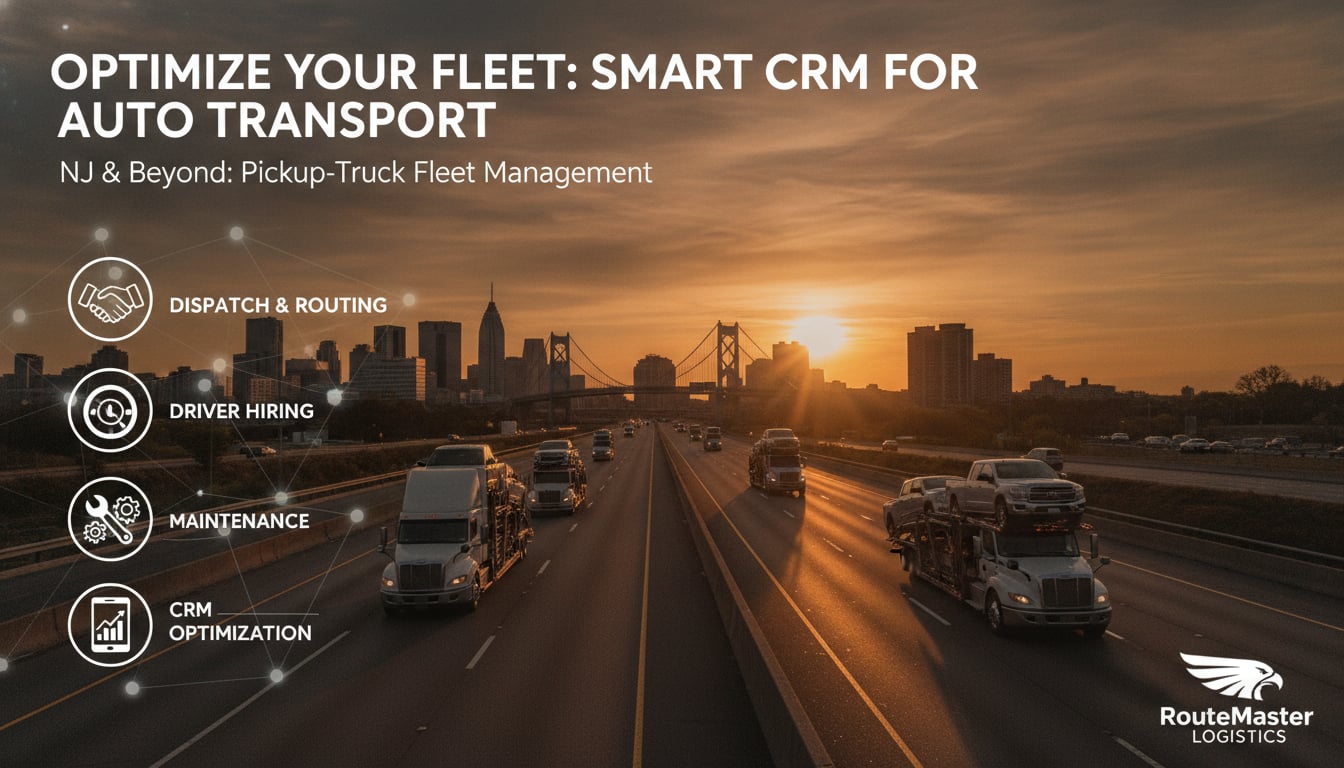
Choosing the Best CRM for Auto Transport Companies in NJ: A Practical Guide for Pickup-Truck Fleet Owners
Discover how choosing the right CRM tailored for pickup-truck fleets can optimize dispatch, routing, driver hiring, and maintenance for auto transport companies in New Jersey and beyond.
In the highly competitive landscape of auto transport in New Jersey, effective customer relationship management (CRM) plays a pivotal role in maintaining operational efficiency, controlling costs, and ensuring customer satisfaction. For pickup-truck fleet owners and auto logistics companies operating across the East Coast, including New Jersey, New York, and Pennsylvania, choosing the right CRM software is not just about managing contacts—it’s about streamlining dispatch operations, optimizing routing and load planning, integrating driver hiring workflows, and supporting fleet maintenance seamlessly.
This article breaks down the critical factors to consider when selecting a CRM tailored specifically for the unique demands of auto transport companies that rely on pickup-truck fleets and in-house operations, such as those at Eagle Pro Alliance. Whether you own a fleet, manage drivers, or oversee maintenance from a truck service center for fleet maintenance in New Jersey, understanding how CRM integrates with every aspect of your logistics operation is essential for sustainable growth.
Why CRM Matters for Pickup-Truck Auto Transport in New Jersey
As a pickup-truck fleet owner operating in New Jersey and servicing routes in neighboring states, the CRM system becomes the command center of your business. With multiple moving parts—dispatched drivers, vehicle availability, maintenance scheduling at your Cherry Hill base at 4 Larwin Rd, and hiring through free CDL training programs—an optimized CRM helps keep all these elements aligned.
Auto transport companies face challenges such as fluctuating fuel prices, load planning complexities, driver turnover, and equipment downtime. A robust CRM tailored to the auto logistics industry can help you:
- Coordinate dispatch and real-time routing to reduce idle miles and improve delivery times.
- Track driver performance and hiring progress, especially when integrating free CDL training.
- Monitor vehicle maintenance schedules in tandem with your in-house shop to avoid unexpected breakdowns.
- Analyze cost per mile and streamline fuel expense management through integrated fuel card programs.
For companies like Eagle Pro Alliance, which operate full-service pickup-truck fleets and provide support services—including fuel cards that save up to 10% on Pilot diesel and truck rentals—the right CRM acts as the nerve center.
Key Features to Look for in a CRM for Auto Transport Companies
1. Pickup-Truck Fleet Efficiency & Dispatch Coordination
The core of your CRM should include dynamic dispatch modules that allow operators and dispatchers to assign jobs based on driver availability, skill level, and location. It should support multi-state compliance features and provide GPS tracking integration to monitor real-time status updates.
2. Routing and Load Planning Integration
Efficient routing directly impacts your bottom line. The CRM should integrate with route optimization software to plan the most fuel-efficient paths for each job. This reduces deadhead miles and cuts unnecessary wear and tear on your fleet, supported by insights from your pickup truck rent and sale options.
3. Cost Per Mile and Fuel Control
Fuel costs are often the largest variable expense in auto transport logistics. A CRM that links fuel data with mileage reports and fuel card usage can help managers enforce fuel budgets, identify anomalies, and negotiate better discount programs. For fleets in New Jersey, using a CRM integrated with the Eagle Pro Alliance fuel card program ensures real-time tax savings and precise cost tracking.
4. Service Center Integration and Preventive Maintenance
Unplanned downtime costs time and potential contracts. Your CRM should work in sync with your truck service center records to schedule preventive maintenance based on mileage, engine hours, or other telematics data. For example, at Eagle Pro Alliance’s Cherry Hill service center, proactive maintenance reduces fleet downtime and improves vehicle reliability across East Coast operations.
5. Driver Hiring and Free CDL Training Workflows
The driver recruitment process is complex by itself. Integrating driver hiring and onboarding directly into the CRM simplifies communication and paperwork management. Eagle Pro Alliance’s model includes free CDL training for new drivers, a unique feature that requires a CRM capable of tracking training progress, certifications, and licensing renewal dates, all accessible by dispatch and operations teams.
Learn more about safe hiring practices and access additional tools at our owner-operators resources.
Real-World Operational Scenario
Consider a New Jersey-based pickup-truck fleet operated by Eagle Pro Alliance that manages deliveries spanning New York and Pennsylvania. Using a CRM with integrated dispatch and routing capabilities, dispatchers can assign the nearest qualified driver, account for their recent training status, and access vehicle service records from the in-house shop at 4 Larwin Rd, Cherry Hill Township, NJ 08034. Fuel expenses, saved through the company’s fuel card program, are automatically reconciled with miles driven. This tight operational integration minimizes downtime while scaling fleet capacity efficiently.
CRM Selection Checklist for Auto Transport Companies
Before making your CRM choice, ensure the system supports:
- Real-time dispatch and routing modules optimized for pickup-truck fleets.
- Integration with fuel card programs and cost per mile monitoring.
- Maintenance scheduling linked directly to in-house service centers.
- Features to track driver hiring, onboarding, and free CDL training progress.
- Multi-state compliance capabilities for New Jersey, New York, and Pennsylvania.
- Reporting tools tailored to logistics KPIs such as load efficiency, turnaround times, and driver utilization.
FAQ / Direct Answers
- Q1: What makes a CRM effective for pickup-truck fleets specifically?
A: Pickup-truck fleets require CRMs that handle smaller, more frequent loads compared to large over-the-road trucks. Effective CRMs integrate dispatch status with fuel usage, vehicle maintenance, and driver availability to keep turnover quick and costs low.
- Q2: How does Eagle Pro Alliance’s CRM support driver hiring and training?
A: At Eagle Pro Alliance, the CRM tracks candidates through our free CDL training program, ensuring dispatch has updated records on driver certifications. This streamlines onboarding and compliance without manual paperwork.
- Q3: Why is integration with a truck service center important in a CRM?
A: Integrating maintenance schedules with dispatch avoids assigning vehicles on the brink of failure. Eagle Pro Alliance uses a truck service center in Cherry Hill, NJ, where maintenance data feeds directly into the CRM to minimize downtime.
- Q4: How does a CRM help control fuel costs?
A: By linking fuel card transactions (like those in the Eagle Pro Alliance fuel discount program) with mileage records, managers can detect fuel discrepancies, optimize routes for gas efficiency, and forecast fuel budgets accurately.
- Q5: Can this type of CRM handle operations across multiple states?
A: Yes. A well-designed CRM for East Coast auto logistics is compliant with varying state regulations and supports multi-jurisdiction dispatching, allowing companies to manage fleets traversing New Jersey, New York, and Pennsylvania seamlessly.
Learn how Eagle Pro Alliance structures efficient pickup-truck auto logistics across the East Coast. Contact Us today!